
AdTech's Pricey Gamble
Why AI is AdTech's Most Expensive Distraction

I’ve been trying to capture the essence of the industry's eternal cycle: find a new buzzword, promise it will fix everything and then use it to more efficiently break what's left. Algorithmically Enhanced Absurdity and Programmatic Paradox are merely prequels to this latest installment. AI: The Automation of All Our Dumb Ideas.

AI in Ad Tech: The New Shiny Garbage Compactor
Remember when programmatic was going to fix everything? That was a good one. It was a promise of efficiency that turned into a fast way to lose 60 cents on the dollar in a supply chain so opaque it makes a politician's tax returns look like a model of transparency. The industry, of course drank it up.

The Trade Desk arrived with OpenPath which they’ll tell you is about transparency and giving advertisers a clean direct line to premium inventory. In reality, it’s their way to cut out the middlemen and unironically be the only middleman. They're not fixing anything. They're just getting a better slice of the dysfunctional pie they helped create. It’s crazy that it is marketed as a gift, when it's part of the problem. You have to sit back in awe of the way this was rolled out as an alternative to the untrustworthy open exchange. The Trade Desk is not the only one. You’ve got MediaMath, which has its own "Source" program and even DV360 has preferred deals and private marketplace. They all have similar tech and as they’re promising a more direct path they are just tighten the grip on their own ecosystem.
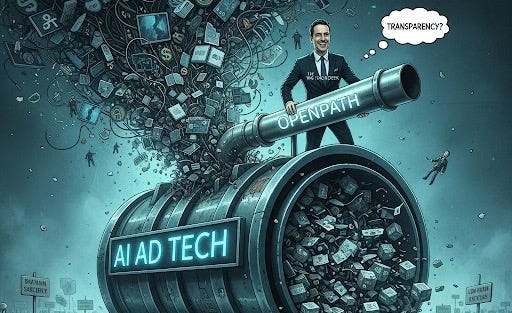
It's a race to see who can build the most cool looking lock on the garden gate.
And they use the same sales pitch as before only with a fresh coat of paint. They're telling us it's going to fix all the problems that programmatic failed to and now we're all nodding along because what else are we supposed to do I guess.
Garbage In, Garbage Out Conundrum
They tell us AI is going to optimize everything. They leave out the part where AI is only as good as the garbage we feed it. We've spent a decade building a data ecosystem that's a digital landfill, riddled with fraud, bots and so much crap you'd think we were trying to tune into a radio station from the 1950s. So what happens when you feed an amazingly smart algorithm that digital trash? Well, to no surprise, it becomes a brilliantly efficient trash compactor. It will flawlessly and confidently optimize your campaigns right into the same worthless inventory you were already buying. The core issue isn't a new problem. It is, however, a new name for an old con.
We're using the most advanced technology to perfectly automate our own mistakes.
Illusion of Efficiency
AI’s real danger isn't failure. It's succeeding perfectly at the wrong job. An algorithm that finds the absolute cheapest ad space available is a marvel of engineering no doubt. But what if that space is on some MFA site designed to do nothing but rip you off? Let’s not wag our finger at AI. It’s doing its job. It found the lowest cost and accelerated the race to the bottom and we're all scrambling to get there first.
We've replaced slow, manual inefficiency with blindingly fast automated inefficiency. It's not a fix but a hell of a lot of wasted money, just faster.
The Problematic Gatekeepers: 2025's False Solutions
While the industry peddles the AI-as-the-savior narrative, a few key players have created "solutions" that only solidify their own positions as the new gatekeepers. They promise to clean up the garbage but they're just getting a better price for hauling a tiny bit of it away.
Integral Ad Science (IAS) positioned as a solution for brand safety and ad fraud and their pre-bid is more often a game of whack-a-mole. The core issue is that their models are still playing catchup to fraudsters who are also using AI to mimic human behavior. A company that promises brand safety but can't fully guarantee it is not a solution, it's another layer of cost.
Scibids: Scibids, acquired by DoubleVerify in 2023, is a prime example of a company selling AI optimization. Their product uses AI to create custom bidding algorithms to improve campaign performance. But, as I wrote earlier, AI is only as good as the data it's trained on and instead of solving for programmatic inefficiency, it adds complexity and cost and requires a specialized skill set to even manage.
Despite the advanced capabilities of algorithmic tools, these systems can be a source of major headaches for advertisers and a truly shitty experience:
Black Box Invisibility: The algorithms are proprietary black boxes and advertisers have little to no visibility into how a bid is ultimately determined. You don't know which specific data points or factors are influencing the algorithm's decision making, and for the record, based on the fact we’re seeing the highest amount of digital waste, ever so we need to question the black box when it’s costing us a fortune. For a media buyer, this makes it nearly impossible to truly understand performance and optimize beyond the basic settings provided by the DSP. You're forced to trust the machine, even when results are poor.
Data Hunger Pains: These algorithms require a significant amount of clean data to learn and optimize effectively. For smaller advertisers or campaigns with low conversion volumes, the algorithms simply don't have enough data to work with. They can't find meaningful patterns and lead to disastrous results and wasted ad spend. It's a classic chicken-and-egg problem. You need conversions for the algorithm to learn, but the algorithm can't get you conversions without a good learning foundation.
Overspending and Budget Waste: While designed to prevent overspending, algorithmic systems can do the opposite. They might aggressively bid on expensive inventory early in a campaign's life burning through a large chunk of the budget with little to show for it. Other times, a poorly performing algorithm might continue to spend on ineffective ad sets or audiences even when human analysis would show a clear need to pivot or if deemed the conversions are not qualified leads. This can lead to significant budget overruns without meeting business goals.
Conflicting Goals and "Selfish" Behavior: A DSP's bidding algorithm may be optimized for one goal, like a CPA, but this will conflict with an advertiser's broader marketing objectives. Like the algorithm might focus exclusively on the cheapest conversions while being fine sacrificing quality or brand safety to meet its numeric goal and it also may engage in bidding behavior that benefits the DSP's own inventory or data partners leading to a "walled garden" effect that disadvantages the advertiser.
A Great Big Human-Sized Hole
Let’s not forget the people. For all the talk of sentient machines and self driving campaigns there's a serious skills gap.
Who truly understands these AI models we're being sold?
The answer is: Not enough people.
And a lot of them just nod and hope for the best.
AI isn't some magical set-it-and-forget-it solution. It requires people who actually understand both the technology and the business it's serving. Without that human expertise AI is just a powerful, expensive mystery that will spit out a result and we'll all just have to hope it's not completely worthless.
My friends, this is the AI conundrum. We're so busy chasing the promise of a perfect automated future that we're ignoring the messy reality of the present. And until we acknowledge that we're just going to keep replicating our own mistakes. Only now with the brilliant speed and scale of a damn supercomputer.
What Do We Do Now? The Ball Is in Our Court.

The AI conundrum isn't something Google, The Trade Desk or any of the other big players are going to fix for us because the current system, for all its flaws, is working exactly as intended for them. It’s a beautifully inefficient machine that keeps the big players fat and happy while leaving us to wonder where it all went.

The only way to change this is to take back control and that starts with the people having their hands on the keyboard. Here's what we can start doing today:
First, let’s own the inconvenient fact that buying on a flat CPM is dumb. It's the digital equivalent of buying a mixed bag of mystery candy and being shocked when 85% of it is the licorice candy no one wants. The idea that a single price point could represent the value of every single impression is a true testament to our collective willingness to accept a flawed system because it's easy. It’s antiquated and belongs in the same museum as dial-up modems. The only way forward is to shift to a dynamic CPM. This means understanding that not all ad impressions are created equal.
Audit Your Data Sources, Relentlessly. Stop accepting the trash in and expecting a miracle solution. Take a good hard look at your first party data. Is it clean? Is it accurate? Does it representative of your audience? If not, fix it! Your AI models are only as good as the data you feed it and the most valuable data you have is the data you own.
Challenge Your Vendors. Don't just accept the black box model and a promise of "efficiency." Demand transparency. Ask how their AI works and what data it's trained on. If they can't give you a straight answer, they're not a partner. They're a magician selling you an expensive trick. Force the conversation to be about outcomes, not just inputs. What is the business result? And for the love, don't settle for "low CPM."
Invest in Human Expertise. Stop treating campaign management as a set-it-and-forget-it function. Up-skill your team or hire people who understand both the technology and the messy reality of the business. You need human intelligence to guide the artificial kind in asking the right questions and knowing when a result looks suspicious.
Embrace the Messy Reality. The perfect automated future is a myth. The present is messy, but that's okay. The path forward isn't to hope for a silver bullet, but it’s more about getting our hands dirty. It’s about building a better data foundation and holding our partners accountable. We need to guide the technology and not the other way around.
The AI conundrum is just a new, shinier version of an old problem. We’ve outsourced our critical thinking to technology. The only way out is to reclaim it. It won't be easy, but it's the only way to turn this incredibly fast and incredibly expensive garbage compactor into a tool that actually works for us.
If you’ve read this far, congratulations! You also enjoy bad marketing called and and not sugar coated.
Either way, thanks for sticking around because I appreciate all of our readers and smart subscribers!
For more brutally honest marketing advice, subscribe below.